

Draftbit vs Bubble: On Bubble, you own your data and Bubble owns the code.
In Draftbit, you own both the app and the backend behind it, as ordinary code you can export on Standard and up. Bubble's manual says you own your data and your app's design, and that "Bubble retains ownership of the underlying code that powers your app", so the thing to decide is whether you'd ever want to run this app anywhere else.
By Brian Luerssen, Founder of Draftbit. Facts checked . Published by Draftbit, one of the two products compared.
Which should you choose?
Choose Draftbit if
- You want to own the code as well as the data, and to export it as an ordinary project.
- You might move the app one day, and you'd rather not rebuild its logic to do it.
- You want a backend you can read and change as code, on a database you choose.
- A developer may take over later, and they'll expect a project they can run with standard tools.
Choose Bubble if
- You'd rather build your app's logic visually, with workflows, a database, and privacy rules in one editor.
- You want one backend for web, iOS, and Android that's hosted and run for you.
- You want to stay in a visual tool and still build with your own Claude, Claude Code, or Codex. With Bubble's connector you can, and the work doesn't use its AI credits.
- You expect to stay on Bubble, so leaving isn't something you need to plan for.
Draftbit vs Bubble at a glance
Both tools make web apps and native mobile apps with a backend behind them, and with both you can now build on your own AI, so these rows are about who owns what you make and what leaving looks like.
| What's compared | Draftbit | Bubble |
|---|---|---|
| Who owns what | ||
| The code | Yours. Mobile apps are React Native and Expo, and web apps, websites, and backends are ordinary Vite, Astro, and Hono projects. | Its manual says "Bubble retains ownership of the underlying code that powers your app". Source : Bubble on the code |
| Your data | Yours, in the database you chose: Cloudflare D1, Supabase, or your own Postgres. | Yours. It exports from the editor as CSV, JSON, or NDJSON. Source : Bubble on your data |
| Leaving | ||
| Code export | ZIP and GitHub export on Standard and up. | Its manual says "there's no way of exporting your application as code". Source : Bubble on code export |
| Moving the app | The export runs with standard tools. You choose a new host and a way to build releases, and keep or move the database. | An AI agent reads the app through Bubble's connector and recreates it in code, which the manual calls "a strong starting point, not a finished app". Source : Bubble on moving the app |
| The backend | ||
| What it is | An API backend in your project on Cloudflare D1, Supabase, or your own Postgres, or a Supabase backend we set up for you. | A built-in database, sign-in, and privacy rules on Bubble, with backend workflows shared by web, iOS, and Android. Source : Bubble on what it is |
| Visual logic | The visual editor covers layout, styles, and the data feeding a field. Logic is code that the agent writes. | Visual workflows. For native mobile apps, its site says the AI generates the UI and sample data, and "You connect workflows and data visually." Source : Bubble on visual logic |
| The AI | ||
| What you build on | Your own Claude or ChatGPT subscription or API key on every plan, Free included, or Draftbit credits. | Bubble AI credits for its own agent, or your own Claude, Claude Code, or Codex through its connector (beta), which doesn't use those credits. Source : Bubble on what you build on |
| Publishing | ||
| App Store and Google Play | Built, signed, and uploaded to App Store Connect and Google Play from the Publish menu, on Standard and up. | Submitted from the editor on a paid plan. Starter includes 5 build submissions a month. Source : Bubble on app store and google play |
Bubble
- Build the app
- Export the data
- Export the code (not available)
- Rebuild the logic (you do this yourself)
- Choose a new host (you do this yourself)
Draftbit
- Build the app
- Export the code
- Choose a new host (you do this yourself)
Who owns what you build
In Draftbit you own the code and the data, and on Bubble you own the data and the design while Bubble owns the code.
That isn’t our reading of it. Bubble’s manual says “Bubble retains ownership of the underlying code that powers your app”, and that “Bubble apps can only be run on the Bubble platform; there’s no way of exporting your application as code”. The same page does say that if Bubble were ever discontinued, its source code would be released under an open-source license, so you could keep your app running on a self-hosted Bubble server.
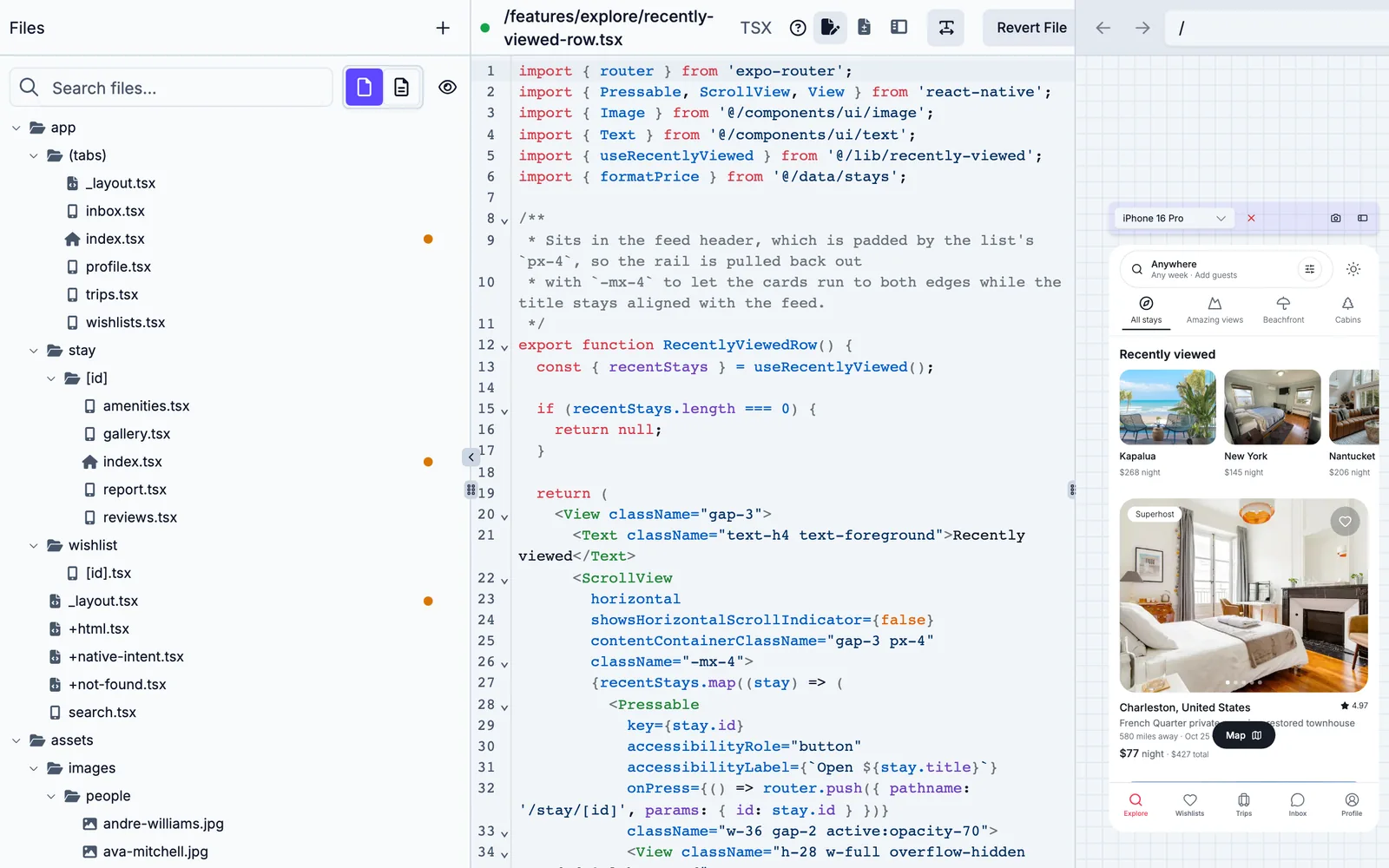
In Draftbit, what the agents write is ordinary code, which means React Native and Expo for mobile apps, and Vite, Astro, or Hono for web apps, websites, and backends. It’s yours, and on Standard and up you can edit it in the builder, download it as a ZIP, or export it to GitHub.
What leaving looks like
Leaving Bubble means rebuilding the app’s logic, and leaving Draftbit means exporting a project that already runs with standard tools.
Bubble’s manual has a page on exporting your app, where an AI agent reads the app through Bubble’s connector and recreates it in code. It calls the result “a strong starting point, not a finished app”. You set up hosting, a database, and sign-in yourself, and because “Bubble doesn’t export user passwords”, your users can’t log in to the new app with the ones they have.
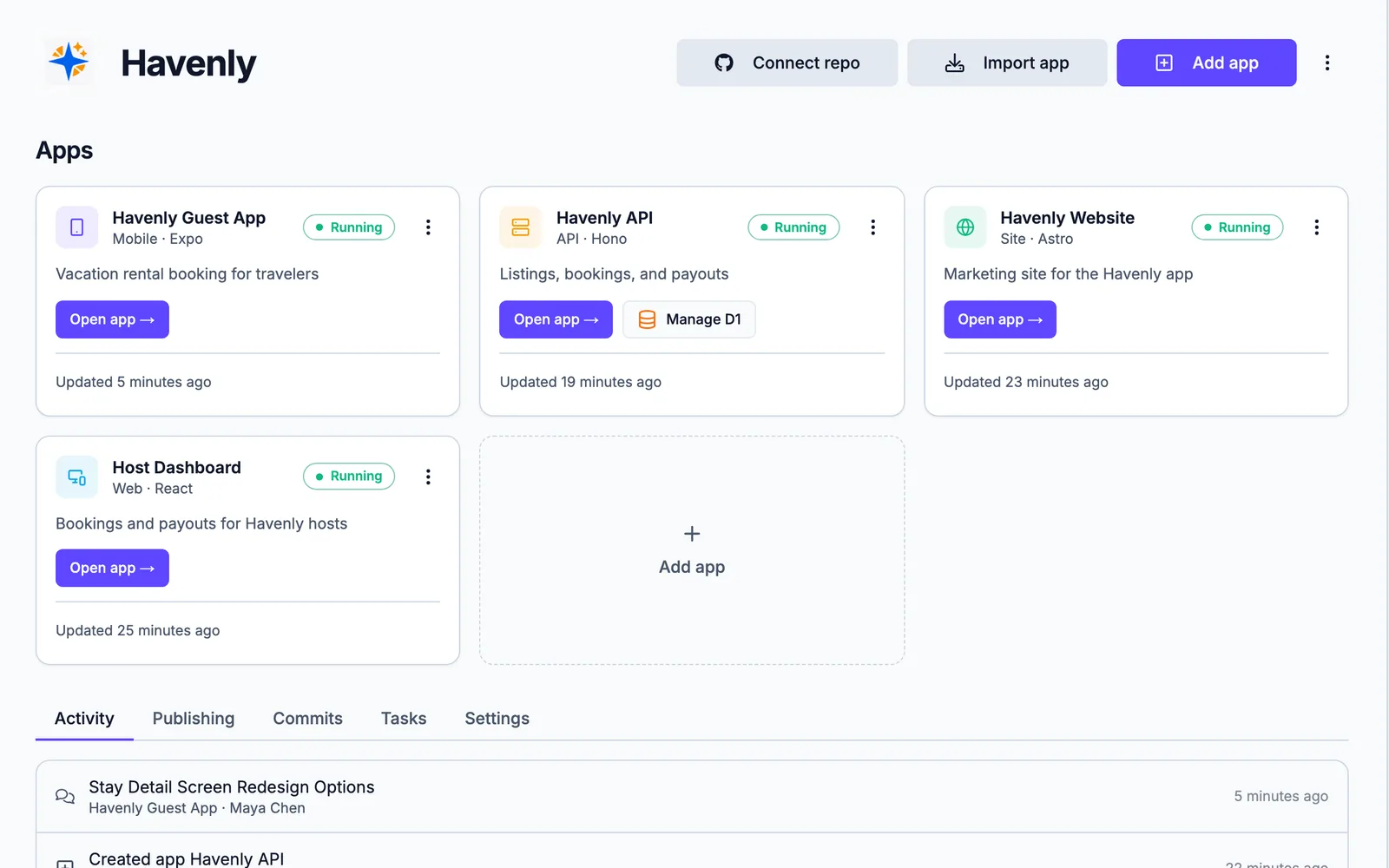
A Draftbit project holds the backend as well as the apps, so an export includes the API’s code along with the screens that call it. Leaving us still takes some work, since you’d choose a new host and a way to build releases, and either keep the database you chose or move a Supabase backend we set up into your own Supabase account.
Building with your own AI
This used to separate the two tools, and since October 2026 it mostly doesn’t.
With Bubble’s connector, which is in beta, you can have Claude, Claude Code, or Codex build in your Bubble account, and its manual says the work “counts toward your account with the AI provider you’re using” and not toward your Bubble AI credits. So if building on your own Claude plan is what brought you here, you can do that on Bubble too. Its release notes list what the connector can’t do yet, which is read logs, merge branches, or deploy.
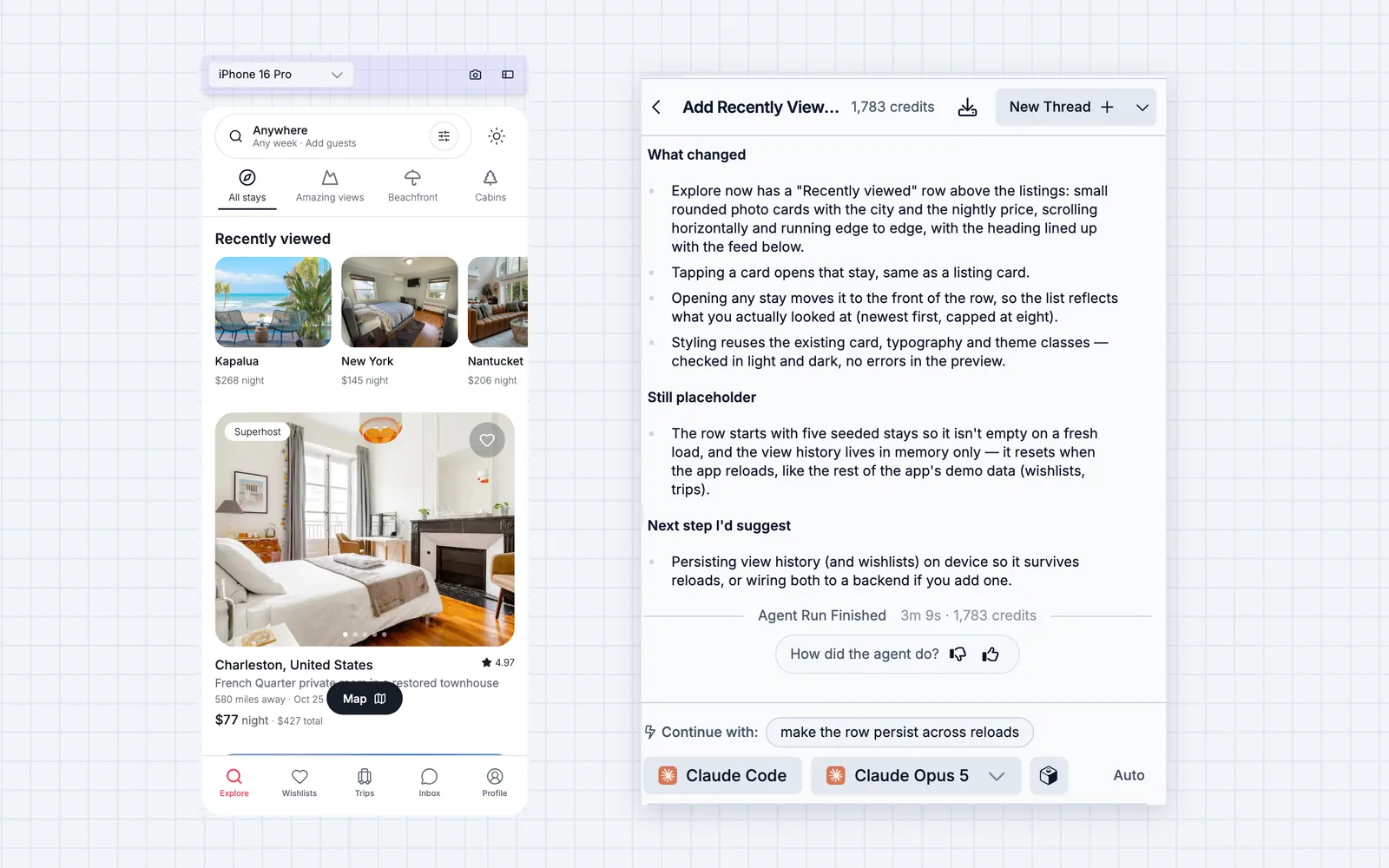
In Draftbit, Claude Code and Codex work inside your project the way they would on a developer’s computer, and you pick the agent and the model on each thread. On every plan, Free included, they can run on your Claude or ChatGPT subscription or your own API key. Nobody has to buy our credits, though we do sell them.
Where Bubble is ahead
If you’d rather build your app’s logic visually than have an agent write it as code, Bubble is the better tool for you.
Bubble comes with a built-in database, sign-in, and privacy rules, and its backend workflows “work across web, iOS, and Android, so you build them once”. All of that is hosted and run for you.
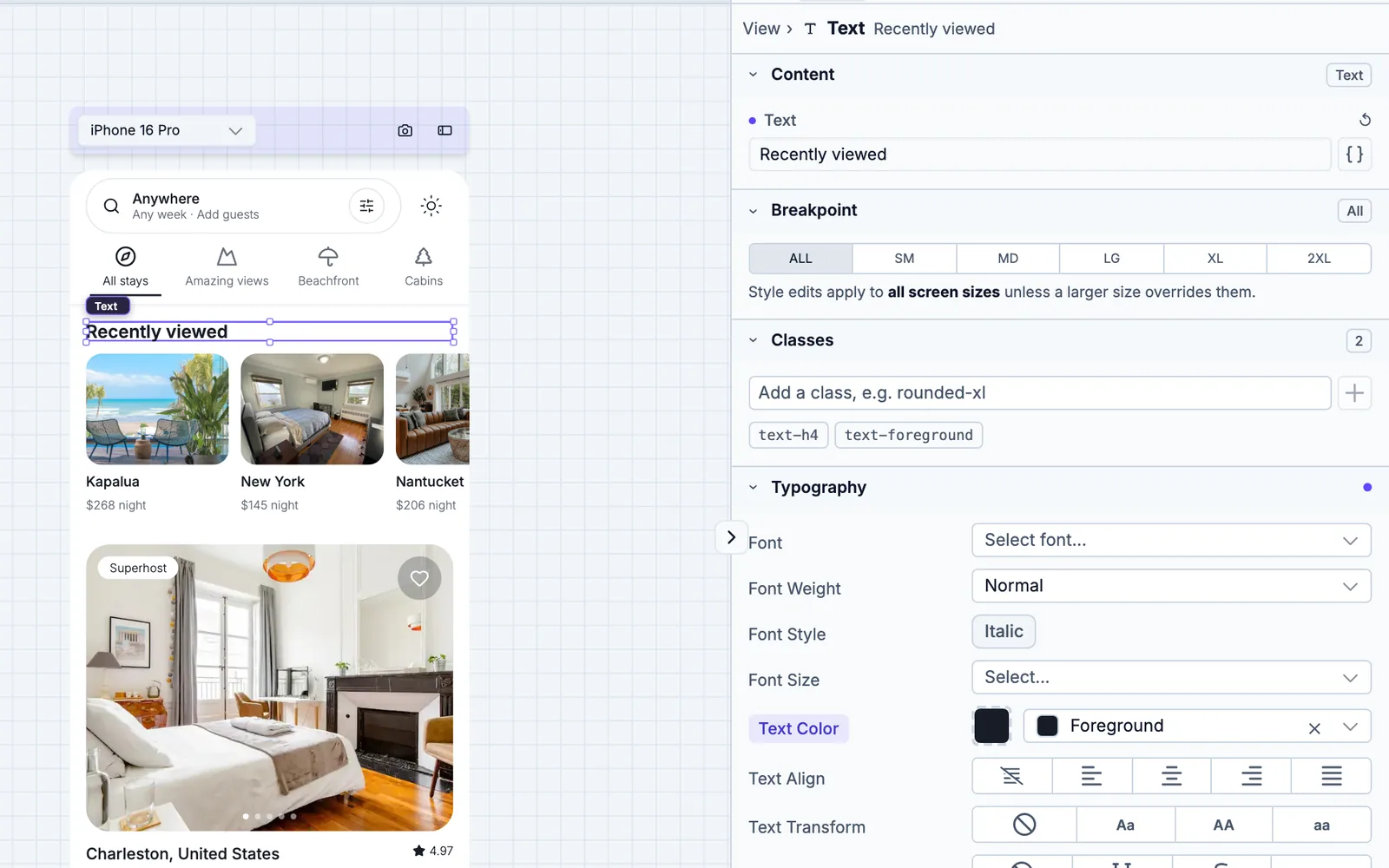
Our visual editor is for a different job. You use it for layout, styles, and the data feeding a field, and it changes the same source files the agents do, while the logic itself is code. That’s what makes the app yours to export, and it also means somebody has to look after that code, even if it’s the agent.
What you'll pay
Draftbit Standard
$15/month; or $144/year ($12/month equivalent)
Base subscription with code editing, ZIP and GitHub export, custom domains, and iOS/Android publishing. AI usage is separate.
Bubble Starter, web and mobile
$69/month, or $59/month billed annually
1,000 AI credits and 175,000 workload units a month, a live website with a custom domain, 5 mobile build submissions a month, and 3 live app versions. Web only is $39 a month, and mobile only is $49.
If you already pay for Claude or ChatGPT, that subscription does the building in Draftbit, so Standard stays at $15 a month. If you'd rather not connect a subscription, you can add Draftbit credits to the plan, from $5 a month for 5,000. Bubble Starter for web and mobile is $69 a month, or $59 a month billed annually, and that covers the hosting, the database, and 175,000 workload units a month under what Bubble calls a usage-based pricing model. A backend isn't free on our side either, because a Supabase backend we set up uses Draftbit credits in staging and production, so add that to Standard if you need one.
Prices are in US dollars and were checked on November 23, 2026. See every Draftbit plan and Bubble's current pricing.
What other sites get wrong about Draftbit
Many comparisons on other sites describe an older Draftbit. Here's what they say, and what's true today.
- Claim Draftbit is a drag-and-drop builder.
- Fact Claude Code and Codex build the app from what you describe. The visual editor is for the changes you'd rather make by hand, and it edits the same code. Read more
- Claim Draftbit has no backend.
- Fact A project can hold an API backend with its own database, or a Supabase backend we set up for you and you can move into your own account. Read more
- Claim You have to buy AI credits.
- Fact You can build on your own Claude or ChatGPT subscription, or your own API key, on every plan, Free included. We sell credits too, for anyone who'd rather buy them from us. Read more
- Claim Draftbit only makes mobile apps.
- Fact It builds mobile apps, web apps, websites, games, and backends, and one project can hold all of them. Read more
What's new at Bubble. On October 7, 2026, Bubble's release notes announced a connector in beta, so Claude, Claude Code, or Codex can build in your Bubble account on your own AI plan, and AI credits, a monthly allowance on every plan for Bubble's own AI features. Its manual also has a page on exporting an app, where an AI agent reads the app through that connector and recreates it in code.
Switching from Bubble
If you're leaving Bubble because you want to own the code, the logic has to be rebuilt wherever you go, and Bubble's own manual says so. What you can bring is the data, which exports from the Bubble editor as CSV or JSON, and the app itself as the reference for what to build.
What you can import into Draftbit is a JavaScript or TypeScript project, and a Bubble app isn't one, so you describe each page and workflow to the agent, and it writes them as code while you adjust the layout by hand in the visual editor. The data can go into an API backend in your project or a Supabase backend we set up for you, and either one is yours to take along later.
Plan for sign-in before you tell your users. Bubble's manual says it doesn't export user passwords, so people will need to set a new one in the rebuilt app, and that's true whichever tool you move to.
There's no need to rush the switch, because the manual also says your Bubble app keeps running while you rebuild.
What Draftbit can import and how Draftbit Experts can do the move for you.
In customers' words
“The visual builder let me focus on features and UX, while the clean code export meant I wasn’t locked in.”
“What helped me the most was the level of freedom it gives you to build a truly professional app without feeling locked into a closed system.”
Test it yourself
Don't take our word for it. Try these in both tools before you decide. Draftbit's Free plan is enough to run them.
- Build your hardest workflow in both tools, then find out where that logic lives and whether you could run it without the tool.
- Look at what each tool lets you take: export your data from Bubble's editor, and in Draftbit open the Code tab on a screen you built.
- Price a month of running the finished app in each, backend included: Bubble's plan and its workload units, and our plan plus credits for a Supabase backend if you use one.
Frequently asked questions
Can I export my Bubble app's code?
Not directly. Bubble's manual says "there's no way of exporting your application as code" and that moving off Bubble means rebuilding the application logic. It also describes a route through its connector, where an AI agent reads your app and recreates it in code, and it calls the result "a strong starting point, not a finished app".
Who owns the code in each?
On Bubble, you own your data and your app's design, and its manual says "Bubble retains ownership of the underlying code that powers your app". In Draftbit the code is yours, app and backend both, with ZIP and GitHub export on Standard and up.
Is Draftbit cheaper than Bubble?
On the plan price, yes. Standard is $15 a month if you bring your own AI, or $15 plus a credit add-on that starts at $5 a month for 5,000 credits, and Bubble Starter is $39 a month for web only or $69 a month for web and mobile. Bubble's price includes its hosting and database, though, and a Supabase backend we set up uses credits in staging and production, so compare the whole month and not only the plan.
Can I move my Bubble app to Draftbit?
Not by importing it. What you can import into Draftbit is a JavaScript or TypeScript project, and a Bubble app isn't one, so the move is a rebuild with your Bubble app as the reference. Your data can come along as CSV or JSON. Bubble's manual says user passwords aren't exported, so your users will need to set new ones.
Do Draftbit's paid plans include AI credits?
No. Standard is $15 a month and that doesn't include credits, because you can build on your own Claude or ChatGPT subscription, or your own API key, on every plan. If you'd rather use Draftbit credits, you can add them to any paid plan, from $5 a month for 5,000.
Can I build on Bubble with my own AI plan?
Yes, through its connector, which launched in beta on October 7, 2026. Bubble's manual says you can connect Claude, Claude Code, or Codex to your Bubble account, and that the work counts toward your account with the AI provider and not toward your Bubble AI credits. Its release notes add that the connector can't read logs, merge branches, or deploy yet. In Draftbit, a Claude or ChatGPT subscription or your own API key works on every plan, Free included.
Does Bubble make native mobile apps?
Yes. Bubble's site says its native mobile apps run on React Native, and that builds are packaged and submitted from its editor on a paid plan. Its manual also says that pages from a Bubble web app have to be rebuilt for the mobile app. In Draftbit, mobile apps are React Native and Expo projects, with one set of source files for iOS and Android.
Sources
We publish Draftbit, so we have a stake in this comparison. Every fact about Bubble comes from its own site and docs, checked on November 23, 2026.
Related comparisons
-
Draftbit vs Adalo
An Adalo app runs on Adalo, and the code costs extra.
-
Draftbit vs FlutterFlow
With FlutterFlow, you have to pick a product.
-
Draftbit vs Glide
A Glide app can't go in the App Store.
On Bubble, you own your data and Bubble owns the code.
Describe the app you'd build on Bubble to the agent, and see how far you get on the Free plan. Whatever you make is code, the backend included, and it's yours to export on Standard and up.